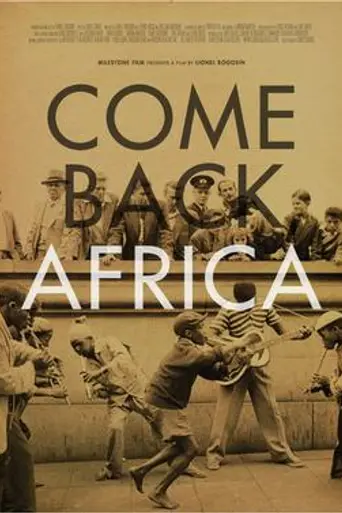
Come Back, Africa is a 1959 film, the second feature-length film written, produced, and directed by American independent filmmaker Lionel Rogosin. The film had a profound effect on South African cinema, and remains historically and culturally important as a document preserving the heritage of the townships in South Africa in the 1950s. It may be classified as reportage, documentary, historical or political cinema, since it portrays real events and people. It reveals an interpretation of meaningful social facts and a strong ethical assumption towards human behaviours like racism.
Like Rogosin's feature debut On the Bowery, Come Back, Africa is a scripted film based on a fictional narrative in which actors play invented roles. However, unlike mainstream films and against Hollywood traditions, its actors are street people, improvising lived experiences: they play their own lives or those of people like them. That is why Come Back, Africa is a hybrid of fictional film and documentary: a docufiction. Additionally, it is a rare combination in film history of docufiction and political film.
Both Lionel Rogosin in America and Jean Rouch in France, at the same time, considered themselves as Robert Flaherty's heirs for similar reasons. Both used amateur actors, "street people" playing their own roles in search of truth or to unveil some hidden mystery beyond crude reality: Rogosin, contrary to Flaherty, was sustained by strong ideological beliefs; Rouch, beyond Flaherty, was inspired by surrealism, which he believed to be a useful means to reveal the truth of cinema (the cinéma-vérité) and also an important tool to be used by an ethnographer for scientific research. Following different paths to reach similar results, both converged in ethnofiction with surprising results.
Source: Wikipedia (CC BY-SA)

No comments yet — be the first.
Sign in — Sign in to leave a comment or review.