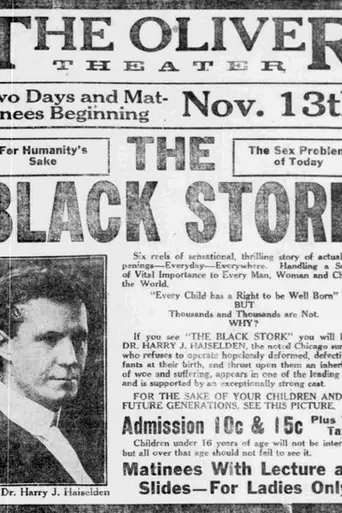
The Black Stork, also known as Are You Fit To Marry?, is a 1916 American eugenic propaganda feature film promoting the star's real-life practice of eugenic infanticide and especially the controversy surrounding the death of Allan J. Bollinger. The film's title references the belief that black storks kill their unhealthy hatchlings.
The film opens with a warning that social problems such as crime and poverty are the result of careless management of human breeding, a core principle of eugenics. The main plot depicts a doctor who refuses life-saving care to a highly dysmorphic newborn baby having serious risks for very poor quality of life, telling the child's mother "God does not want this child to live." The medical profession is outraged, but the child's mother has a vision in which her child is visibly disabled, unhappy, and violent, and who has five disabled children of his own. As a result of this vision, she agrees to let the child die, and the film ends with Jesus receiving the infant's soul as the doctor looks on.
The film was extremely controversial at its initial release. Though Haiselden's actual infanticide had many supporters, the film itself was regarded as both poor quality and morally offensive. Despite the public backlash, The Black Stork was still shown nationwide as late as 1928. After 1918, the movie was renamed Are You Fit To Marry? and remained in theaters and traveling road shows as late as 1942.
Source: Wikipedia (CC BY-SA)
No comments yet — be the first.
Sign in — Sign in to leave a comment or review.